


Alkanes
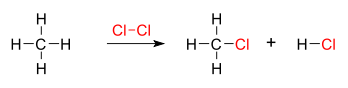
Alkanes react with halogens by free radical halogenation. In this reaction a hydrogen atom is removed from the alkane, then replaced by a halogen atom by reaction with a diatomic halogen molecule. The reactive intermediate in this reaction is a free radical and the reaction is called a radical chain reaction.
Free radical halogenation typically produces a mixture of compounds mono- or multihalogenated at various positions. It is possible to predict the results of a halogenation reaction based on bond dissociation energies and the relative stabilities of the radical intermediates. Another factor to consider is the probability of reaction at each carbon atom, from a statistical point of view.
The diagram below is for free radical halogenation
Alkenes and alkynes
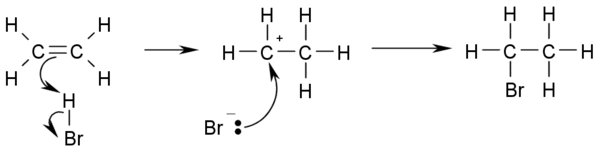
In hydrohalogenation, an alkene reacts with a dry hydrogen halide (HX) like hydrogen chloride (HCl) or hydrogen bromide (HBr) to form a mono-haloalkane. The double bond of the alkene is replaced by two new bonds, one with the halogen and one with the hydrogen atom of the hydrohalic acid. Markovnikov's rule states that in this reaction, the halogen is more likely to become attached to the carbon within the double bond that already has more hydrogen atoms. This is a electrophilic addition reaction. Water must be absent otherwise there will be a side product of a cyanohydrin. The reaction is necessarily to be carried out in a dry inert solvent such as CCl4 or directly in the gaseous phase. The reaction of alkynes are similar, with the product being a geminal dihalide; once again, Markovnikov's rule is followed.
Alkenes also react with halogens (X2) to form haloalkanes with two neighboring halogen atoms in a halogen addition reaction. Alkynes react similarly, forming the tetrahalo compounds. This is sometimes known as "decolorizing" the halogen, since the reagent X2 is colored and the product is usually colorless.
The diagram below is for hydrohalogenation
Alcohols
Tertiary alkanol reacts with hydrochloric acid directly to produce tertiary chloroalkane, but if primary or secondary alkanol is used, an activator such as zinc chloride is needed.
The most popular conversion is effected by reacting the alcohol with thionyl chloride in the "Darzen's process," which is one of the most convenient laboratory methods because the byproducts are gaseous. Both phosphorus pentachloride (PCl5) and phosphorus trichloride (PCl3) also convert the hydroxyl group to the chloride. Alcohol may likewise be converted to bromoalkane using hydrobromic acid or phosphorus tribromide (PBr3). A catalytic amount of PBr3 may be used for the transformation using phosphorus and bromine; PBr3 is formed in situ. Iodoalkanes may similarly be prepared using using red phosphorus and iodine (equivalent to phosphorus triiodide).
Halogenoarenes (aryl halides)
To produce a halide of a benzene ring, a substitution reaction with a halogen is needed. The following example ilustrates the chlorination of benzene in the presence of a catalyst. Further substitution can occur in the benzene ring until all hydrogen atoms are replaced by halogen atoms.
Biosynthesis
Many chloro and bromolkanes are formed naturally. The principal pathways involve the enzymes chloroperoxidase and bromoperoxidase. More about natural organic halogens can be found in Organic Halides in Nature.
The diagram below is Chloroperoxidase


Pictures

Comments (3)
Mai Ghannam said
at 4:54 pm on Mar 4, 2010
i'm sorry for sounding mean though, i'm just really stressed out right now
Mai Ghannam said
at 10:22 pm on Mar 3, 2010
oops sorry, wrong one, but for this one you need to edit it or me and farz will do it.
Mai Ghannam said
at 10:20 pm on Mar 3, 2010
Zeinab, you need to actually start doing something. Most of this info is not relevant.
You don't have permission to comment on this page.